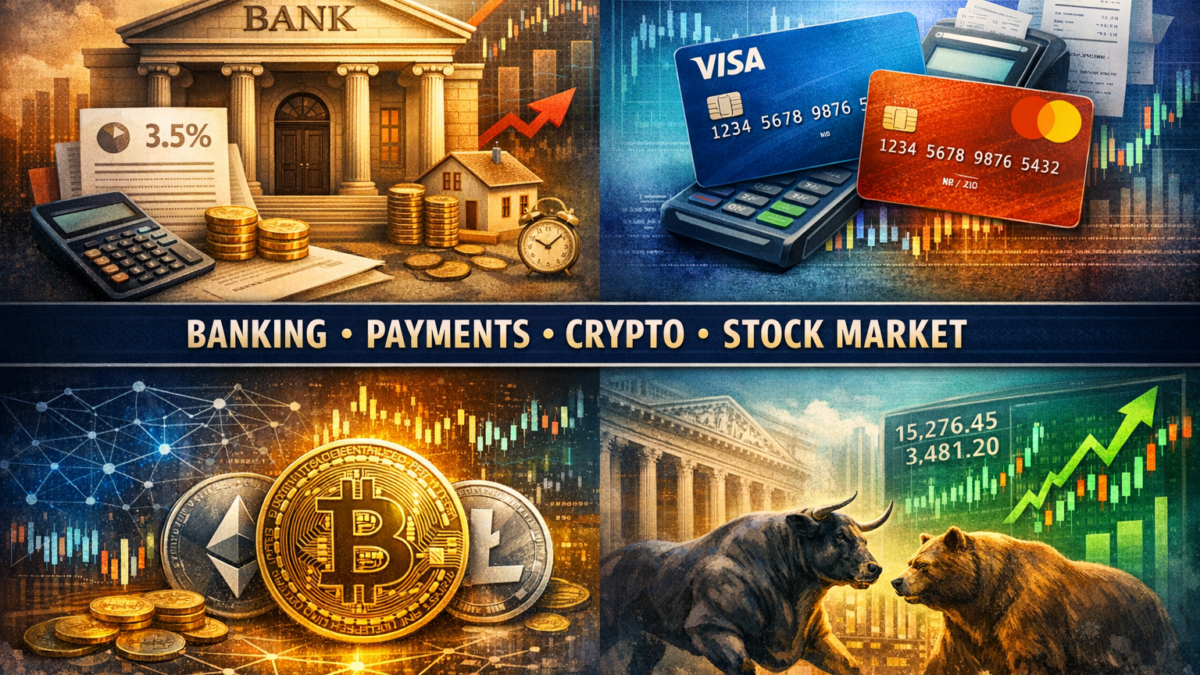
The global financial system has evolved dramatically over the past century. From traditional brick-and-mortar banks to digital payment cards, from stock exchanges to decentralized cryptocurrencies, money today moves faster and more freely than ever before. Understanding how banks operate, how interest rates affect individuals and businesses, how payment networks like Visa and Mastercard function, and how cryptocurrencies and stock markets differ is essential for anyone living in a modern economy.
This article provides a detailed and neutral overview of these financial pillars. It does not promote specific products or investments but aims to explain how the system works, why it exists, and how its different parts are connected.
1. Banks: The Backbone of the Financial System
1.1 What Is a Bank?
A bank is a financial institution licensed to accept deposits, provide loans, and offer payment and money management services. Banks act as intermediaries between people who save money and those who need capital.
At their core, banks perform three main functions:
- Safekeeping money
- Lending money
- Facilitating paymentsWithout banks, modern economies would struggle to function efficiently.
1.2 Types of Banks
There are several types of banks, each serving different purposes:
Commercial Banks
These are the most common banks used by individuals and businesses. They offer checking accounts, savings accounts, loans, and credit cards.
Central Banks
Central banks, such as the Federal Reserve or the European Central Bank, control monetary policy, regulate the money supply, and supervise commercial banks.
Investment Banks
Investment banks focus on capital markets, helping companies raise money through stocks and bonds, and advising on mergers and acquisitions.
Online and Digital Banks
These banks operate primarily through digital platforms, often offering lower fees due to reduced operational costs.
2. Interest Rates: The Price of Money
2.1 What Are Interest Rates?
Interest is the cost of borrowing money or the reward for saving it. When you deposit money in a bank, the bank pays you interest. When you take a loan, you pay interest to the bank.
Interest rates are usually expressed as a percentage over a specific period, typically annually.
2.2 How Banks Use Interest
Banks generate profit mainly through the difference between:
- The interest they pay to depositors
- The interest they charge borrowersThis difference is known as the interest spread.
2.3 Factors Influencing Interest Rates
Several factors influence interest rates:
- Central bank policies
- Inflation levels
- Economic growth
- Risk associated with borrowersWhen central banks raise interest rates, borrowing becomes more expensive, and spending may slow down. When rates are lowered, borrowing becomes cheaper, encouraging economic activity.
2.4 Interest Rates and Consumers
Interest rates affect everyday financial decisions, including:
- Mortgage costs
- Personal loans
- Credit card balances
- Savings account returnsEven small changes in interest rates can have significant long-term effects.
3. Payment Cards: Visa and Mastercard
3.1 What Are Payment Cards?
Payment cards allow consumers to make cashless transactions. The most common types are:
- Debit cards
- Credit cards
- Prepaid cardsVisa and Mastercard are not banks; they are global payment networks.
3.2 Visa and Mastercard: How They Work
Visa and Mastercard operate as intermediaries between:
- The cardholder
- The merchant
- The issuing bank
- The acquiring bankWhen a card is used:
- The payment request is sent to the network.
- The issuing bank verifies funds or credit.
- The transaction is approved or declined.
- Funds are settled between banks.This process happens in seconds.
3.3 Differences Between Visa and Mastercard
From a consumer perspective, Visa and Mastercard are very similar. Differences mainly exist in:
- Network reach
- Security technologies
- Partnerships with banksBoth networks operate globally and are accepted in millions of locations.
3.4 Advantages of Card Payments
- Convenience
- Speed
- Security features
- Transaction records
- Online and international usability3.5 Risks and Limitations
- Fees for merchants
- Potential for overspending
- Dependence on digital infrastructure
- Exposure to fraud if security is compromised4. Cryptocurrencies: A New Financial Paradigm
4.1 What Is Cryptocurrency?
Cryptocurrency is a form of digital money that uses cryptography for security and operates on decentralized networks called blockchains.
Unlike traditional currencies, most cryptocurrencies are not controlled by a central authority.
4.2 Blockchain Technology
A blockchain is a distributed ledger that records transactions across many computers. Once data is recorded, it is difficult to alter, providing transparency and security.
4.3 Popular Cryptocurrencies
- Bitcoin (BTC)
- Ethereum (ETH)
- Litecoin (LTC)
- Other blockchain-based tokensEach cryptocurrency has different features and use cases.
4.4 How Cryptocurrencies Are Used
Cryptocurrencies can be used for:
- Digital payments
- Peer-to-peer transfers
- Smart contracts
- Decentralized applications4.5 Volatility and Risk
Cryptocurrency prices are highly volatile and influenced by:
- Market sentiment
- Regulation news
- Technological developments
- Adoption ratesDue to this volatility, cryptocurrencies are often viewed as high-risk assets.
4.6 Regulation and Legal Status
Governments around the world approach cryptocurrencies differently. Some regulate them strictly, others allow limited use, and some are still developing legal frameworks.
5. Stock Markets: Ownership and Capital Growth
5.1 What Is the Stock Market?
The stock market is a platform where shares of publicly listed companies are bought and sold. Owning a stock represents partial ownership in a company.
5.2 How Stock Exchanges Work
Stock exchanges provide:
- Price discovery
- Liquidity
- Transparency
- RegulationTrades occur through brokers, either traditional or online.
5.3 Types of Stocks
- Common stocks
- Preferred stocksStocks may provide:
- Capital appreciation
- Dividends5.4 Market Indexes
Indexes track the performance of groups of stocks, such as:
- S&P 500
- Dow Jones Industrial Average
- NASDAQ CompositeIndexes are often used as economic indicators.
5.5 Risks in the Stock Market
Stock prices can fluctuate due to:
- Company performance
- Economic conditions
- Political events
- Global crisesMarkets can experience both long-term growth and short-term declines.
6. Comparing Banks, Stocks, and Cryptocurrencies
6.1 Centralization vs Decentralization
- Banks and stock markets are centralized and regulated.
- Cryptocurrencies are largely decentralized.6.2 Stability vs Innovation
- Banks offer stability and protection.
- Cryptocurrencies offer innovation and flexibility.6.3 Accessibility
Digital finance has made access easier, but barriers still exist, such as:
- Regulation
- Technical knowledge
- Infrastructure7. The Future of Finance
7.1 Digital Transformation
Banks are increasingly adopting:
- Mobile banking
- Digital wallets
- Contactless payments7.2 Central Bank Digital Currencies (CBDCs)
Many countries are exploring digital versions of national currencies to combine the benefits of digital payments with state-backed stability.
7.3 Integration of Financial Systems
The future may see closer integration between:
- Traditional banks
- Payment networks
- Blockchain technology